This site is intended for US healthcare professionals only.

PATHWAYS DRIVING PsO
Dive into the differences beneath the surface
Psoriasis is driven by multiple pathways1-3
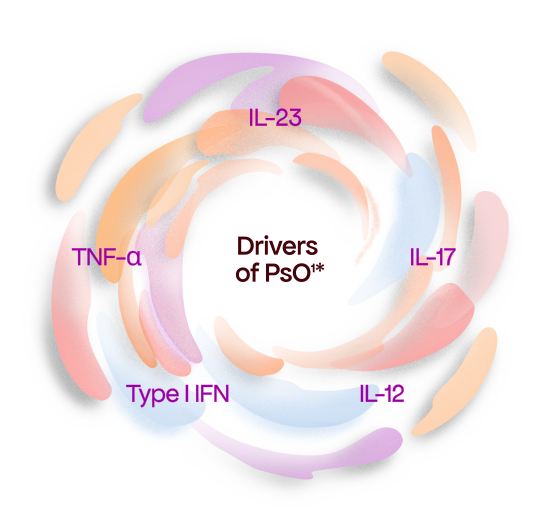
Beneath the visible differences in PsO lies a complex network of inflammatory signaling.1,2
Emerging insights suggest that multiple pathways are involved in psoriasis, including the IL-23/IL-17 axis, Type I IFN, IL-12, and TNF‑α.1,2
The relative activity of these pathways may vary from patient to patient, potentially contributing to differences in clinical presentation.1,2
*This image shows selected drivers that may play a role in PsO and is not meant to represent every pathway involved.
Drivers of PsO
IL-23
Drives the survival and proliferation of Th17 cells, promoting downstream production of IL-17.1,4
IL-17
Promotes inflammatory signaling and activates keratinocytes, contributing to plaque formation and persistence.1,4
Type I IFN
Initiates early immune activation by stimulating dendritic cells and keratinocytes, helping trigger the inflammatory cascade.1,4
TNF-α
Activates immune and skin cells, helping amplify and sustain inflammation, and contributing to keratinocyte activation and hyperproliferation.1,4
IL-12
Promotes the Th1 immune response and IFN-γ production, contributing to the initiation of inflammatory signaling.1,4
Multiple pathways signal via TYK22,5
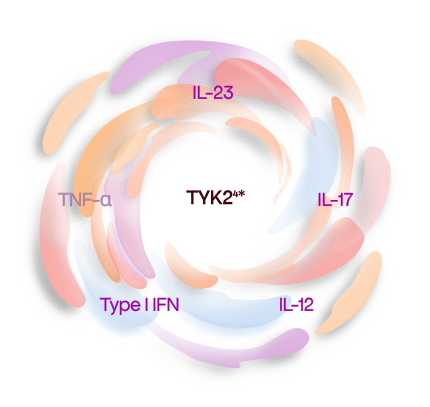
The IL-23/IL-17 axis, IL-12, and Type I IFN, which play distinct roles in PsO, all signal through TYK2.2,5
As a shared mediator across these inflammatory pathways, TYK2 is a key hub for multiple inflammatory pathways that drive PsO.5
*This image shows selected drivers that may play a role in PsO and is not meant to represent every pathway involved.
Variability in clinical presentation and treatment response may reflect the heterogeneous biology underlying PsO.4-7


Many patients remain dissatisfied despite recent advancements in PsO therapies.8

Takeda’s commitment
Takeda brings 245 years of scientific experience to a renewed focus in
dermatology, applying its legacy of innovation towards advancing research and education in PsO.
Through continued collaboration, education, and an ongoing commitment to addressing unmet needs, Takeda aims to help
improve outcomes for people living with psoriatic disease.
IFN=interferon; IL=interleukin; PsO=psoriasis; Th=T helper; TNF=tumor necrosis factor; TYK=tyrosine kinase.
References
- Sieminska I, Pieniawska M, Grzywa TM. The immunology of psoriasis-current concepts in pathogenesis. Clin Rev Allergy Immunol. 2024;66(2):164-191.
- Armstrong AW, Blauvelt A, Callis Duffin K, et al. Psoriasis. Nat Rev Dis Primers. 2025;11(1):45.
- Cantó E, Del Prado ME, Villarrasa E, et al. Transcriptomic identification of immune-related hubs as candidate predictor biomarkers of therapeutic response in psoriasis. Int J Mol Sci. 2025;26(17):8118.
- Kircik L, Aldredge LM, DiRuggiero D. Selective tyrosine kinase 2 (TYK2) inhibition in plaque psoriasis. J Drugs Dermatol. 2024;23(8):645-652.
- Shang L, Cao J, Zhao S, Zhang J, He Y. TYK2 in immune responses and treatment of psoriasis. J Inflamm Res. 2022;15:5373-5385.
- Abduelmula A, Gooderham MJ. TYK2 inhibition: changing the treatment landscape for psoriasis? Expert Rev Clin Immunol. 2022;18(3):185-187.
- Martin G. Novel therapies in plaque psoriasis: a review of tyrosine kinase 2 inhibitors. Dermatol Ther (Heidelb). 2023;13(2):417-435.
- Merola JF, Ogdie A, Gottlieb AB, et al. Patient and physician perceptions of psoriatic disease in the United States: results from the UPLIFT survey. Dermatol Ther (Heidelb). 2023;13(6):1329-1346.