This site is intended for US healthcare professionals only.

ABOUT PSORIASIS
Psoriasis is an immune-mediated, chronic skin disease1
~7.5 million people in the US live with PsO2
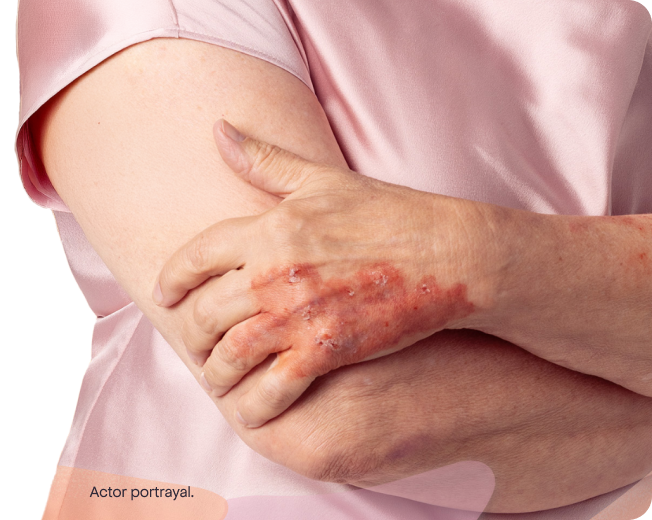
>80% of PsO diagnoses are chronic plaque PsO3
Chronic plaque PsO is the most common form of PsO which presents as patches or plaques that are3:

Sharply demarcated

Erythematous

Scaly
The systemic inflammatory nature of PsO is associated with multiple comorbidities4,5

These comorbidities include4,5:
- PsA and long-term joint damage
- Elevated cardiovascular and cardiometabolic risk
- Increased risk of depression and anxiety
Systemic therapies may be underutilized6

Only ~67% of patients who self-identified as having moderate-to-severe PsO were on systemic therapy,
representing a potential underutilization of systemic therapies.6*
*The UPLIFT survey consisted of PsO patients (n=535), PsA patients (n=72), and PsO and PsA patients (n=399). Self-identification of
moderate to severe psoriasis was defined as 4 to >10 palms of total body area covered by plaques.6
Many patients remain dissatisfied
despite recent advancements in
PsO therapies6
Even after initial improvement, many patients continue to experience residual
plaques and ongoing disease impact.1,7
In a 2024 registry study of 1,560 adults with PsO:
1 in 5 patients
reported being dissatisfied or very dissatisfied with their current systemic or topical treatment.4
In a 2017 to 2021 registry study of 151 adults with PsO
1 in 2 patients
who switched following biologic therapy cited failure to maintain response as the primary reason.5
In a 2024 study of
386 patients:
7 out of 10 patients
reported that PsO impacted their emotional well-being.8
Nonresponse to various therapies suggests that different disease pathways may be involved across patients with PsO.5,9,10


Variability in PsO presentation is also a factor in the patient experience.
Takeda’s commitment
Takeda brings 245 years of scientific experience to a renewed focus in
dermatology, applying its legacy of innovation towards advancing research and education in PsO.
Through continued collaboration, education, and an ongoing commitment to addressing unmet needs, Takeda aims to help
improve outcomes for people living with psoriatic disease.
PsA=psoriatic arthritis; PsO=psoriasis; UPLIFT=Understanding Psoriatic Disease Leveraging Insights for Treatment.
References
- Armstrong AW, Blauvelt A, Callis Duffin K, et al. Psoriasis. Nat Rev Dis Primers. 2025;11(1):45.
- Armstrong AW, Mehta MD, Schupp CW, et al. Psoriasis prevalence in adults in the United States. JAMA Dermatol. 2021;157(8):940-946.
- Armstrong AW, Read C. Pathophysiology, clinical presentation, and treatment of psoriasis: a review. JAMA. 2020;323(19):1945-1960.
- Song WB, Michaud K, Lonowski SL, et al. The FORWARD psoriasis registry: patient-reported outcomes in a novel psoriasis registry and comparison of traditional, dermatologist-led enrollment with web-based patient enrollment. J Psoriasis Psoriatic Arthritis. 2025;10(2):37-50.
- Blauvelt A, McLean RR, Beaty SW, et al. Impact of disease burden of patients with psoriasis on biologic therapy switch: real-world evidence from the CorEvitas Psoriasis Registry. Dermatol Ther (Heidelb). 2024;14(10):2787-2804.
- Merola JF, Ogdie A, Gottlieb AB, et al. Patient and physician perceptions of psoriatic disease in the United States: results from the UPLIFT survey. Dermatol Ther (Heidelb). 2023;13(6):1329-1346.
- Armstrong AW, Bohannan B, Mburu S, et al. Patient perspectives on psoriatic disease burden: results from the Global Psoriasis and Beyond Survey. Dermatology. 2023;239(4):621-634.
- Armstrong A, Levi NA, Schneider B, et al. Patient-identified treatment goals for psoriatic disease: results from a US patient survey. J Psoriasis Psoriatic Arthritis. 2024;10(1):11-21.
- Li L, Liu J, Lu J, et al. Interventions in cytokine signaling: novel horizons for psoriasis treatment. Front Immunol. 2025;16:1573905.
- Francis L, Capon F, Smith CH, Haniffa M, Mahil SK. Inflammatory memory in psoriasis: from remission to recurrence. J Allergy Clin Immunol. 2024;154(1):42-50.